Originally reported 1957
From the Vault: The Sunday Morning Three Navy Cadets Walked Into Kersey, and the Bells Stopped
In October 1957, three 15-year-old Royal Navy cadets on a map-reading exercise in Suffolk said they entered a silent village with no people, no wires and no church, and a butcher's window full of rotting carcasses. Decades later, a psychical researcher concluded they had seen Kersey as it was in the Middle Ages. A historian has his doubts. Here's the record.
Location Kersey, near Hadleigh, Suffolk, England
KERSEY, England (Originally reported 1957): Looking back, the strangest thing was the silence.
On a Sunday morning in October 1957, three Royal Navy cadets, all 15, were crossing the Suffolk countryside on a map-reading exercise. Their goal was a waypoint near the village of Kersey, near Hadleigh, roughly 12 miles west of Ipswich. As they came over the hill, by their account, they could hear church bells and see smoke rising from chimneys.
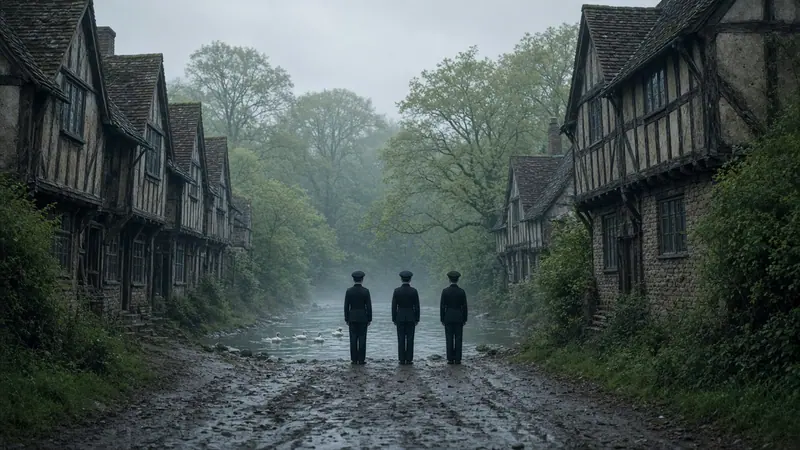
Then they walked down into the village, and everything stopped. The bells. The birdsong. The breeze. In the stream that crossed the road, white ducks sat still in the water. The street was empty of people, cars, wires and aerials. In a shop window, two or three skinned ox carcasses hung green with age.
“It was a ghost village, so to speak,” one of the boys said years later. “It was almost as if we had walked back in time.”
Sixty-nine years on, the East Anglian Daily Times calls it “one of Suffolk’s creepiest stories.” It rests almost entirely on the memories of two men, written down some three decades after the fact.
What we know
On the record: documents, statements, dates and places. Sources below.
- The cadets. According to Smithsonian magazine’s 2011 account by the writer Mike Dash, the three were William Laing, from Perthshire in Scotland; Michael Crowley, from Worcestershire; and Ray Baker, a Londoner Dash describes as a Cockney. All three were 15 and had only recently joined the Royal Navy. None knew the area.
- The exercise. They were to navigate four or five miles of countryside to a set point, then return to base and report what they had seen, Dash wrote. If all went to plan, that should have been Kersey. Because the boys were strangers to the area, their instructors could confirm they’d found the right village just by checking their descriptions.
- The first report. When the cadets told their superiors what they had experienced, Laing recalled, the petty officers were “rather skeptical” but “laughed it off and agreed that we’d seen Kersey all right.” That was the end of it for three decades.
- The phone call. In the late 1980s, according to Smithsonian, Laing and Crowley, by then both living in Australia, talked by phone and went over the incident. Crowley didn’t remember it in as much detail, Dash wrote, but recalled the silence, the lack of aerials and streetlights, and the butcher’s shop. Laing then wrote to Andrew MacKenzie, an author and leading member of the Society for Psychical Research.
- The investigation. MacKenzie and Laing corresponded for two years, according to Smithsonian, and MacKenzie researched the village’s history with help from a Kersey historian. In 1990, Laing flew to England and the two walked through the village together. The East Anglian Daily Times, in a 2019 “Weird Suffolk” feature, also places the visit in 1990 and says Laing was then living in Australia.
- The book. MacKenzie made Kersey the lead case in Adventures in Time (1997), his book on retrocognition, the Society for Psychical Research’s term for perceiving the past by paranormal means.
- The third cadet. Ray Baker was also traced, Smithsonian reported, but he remembered nothing of the experience. The Daily Star, in a Sept. 15, 2026, retelling, says Baker “denied ever experiencing” what the other two described.
What’s claimed
Accounts, testimony and theories, as told by the people who tell them.
The account of that morning comes from Laing and Crowley, as quoted by MacKenzie and retold by Dash, the East Anglian Daily Times and the Daily Star.
- The silence. The church bells stopped as the boys neared the village, Dash wrote. Even the ducks by the shallow stream were quiet and motionless. One of the boys later compared them to decoys, according to the Daily Star. The autumn birdsong faded, the wind dropped to nothing and not a leaf stirred. The trees, Dash wrote, seemed to cast no shadows.
- The season. Inside the village, Laing recalled, “it was verdant… and the trees were that magnificent green colour one finds in spring or early summer.” Outside, it was October.
- Nothing modern. There were no cars, phone wires or aerials, according to Smithsonian. The EADT adds that there were no streetlights and no TV aerials. The houses looked ragged, hand-built and timber-framed, “almost medieval in appearance,” one boy thought.
- The butcher’s shop. One of the cadets described the window for MacKenzie, as quoted by Smithsonian: “There were no tables or counters, just two or three whole oxen carcasses which had been skinned and in places were quite green with age. There was a green-painted door and windows with smallish glass panes, one at the front and one at the side, rather dirty-looking. I remember that as we three looked through that window in disbelief at the green and mouldy green carcasses… the general feeling certainly was one of disbelief and unreality… Who would believe that in 1957 that the health authorities would allow such conditions?”
- The empty houses. Another house had greenish, smeary windows and crudely whitewashed walls, with no furniture or possessions inside, Dash wrote. The boys thought the rooms looked “not of modern day quality.”
- The watchers. “I experienced an overwhelming feeling of sadness and depression in Kersey,” Laing said, “but also a feeling of unfriendliness and unseen watchers which sent shivers up one’s back… I wondered if we’d knocked at a door to ask a question who might have answered it? It doesn’t bear thinking about.”
- No church. “There was no sign of a church,” Laing recalled. “I would certainly have seen it as I had a field of observation of 360 degrees.” Crowley likewise recalled “no church or pub,” according to Smithsonian.
- The way out. Spooked, the cadets hurried out of the village and up a small hill, and didn’t look back until they reached the top. “Suddenly we could hear the bells once more and saw the smoke rising from chimneys,” one recalled. “None of the chimneys was smoking when we were in the village… We ran for a few hundred yards as if to shake off the weird feeling.”
The researcher’s case
MacKenzie concluded that the cadets had seen Kersey not as it was in 1957, but as it had been centuries earlier. According to Smithsonian, several things persuaded him: the obvious sincerity of Laing and Crowley, the detail of their memories, and a few discoveries in the records.
- The butcher’s house. The building Laing identified as a butcher’s shop was a private home in 1957 and still was in 1990. But it dated to about 1350, Dash wrote, and had been a butcher’s shop at least as early as 1790. The EADT reports that MacKenzie found it had been registered as a butcher’s shop from 1790 to 1905, and could possibly have been associated with the trade for centuries.
- The missing church. St. Mary’s, Kersey, dates to the 14th century and is the main landmark in the district, Dash wrote. Construction of its tower was halted by the Black Death of 1348 to 49, which killed half of Kersey’s population. MacKenzie suggested that in the plague years, the half-built church would have been hidden by trees. The Daily Star reports that the tower stood unfinished for decades before it was completed in 1481.
- The date. Because the cadets remembered glazed windows, a rarity in the Middle Ages, MacKenzie proposed that the most likely date was around 1420, Dash wrote, when the church was still unfinished but the village was growing rich from the wool trade.
MacKenzie set Kersey alongside the most famous retrocognition case of all, Dash noted. That was the “Versailles incident” of 1901, in which two senior academics from St Hugh’s College, Oxford, came to believe they had seen the palace gardens as they were before the French Revolution. When MacKenzie read Laing the Versailles account’s description of trees that looked “flat and lifeless, like a wood worked in tapestry,” Laing said it was “spot on.”
The historian’s questions
Dash, writing in 2011, said he would love to believe the story but couldn’t, without better evidence. His reasons, in brief:
- An old village to begin with. Kersey is genuinely ancient, first mentioned in an Anglo-Saxon will of about 900, and still has many medieval buildings, Dash wrote. Nikolaus Pevsner called it “the most picturesque village in South Suffolk.” Among its buildings is the 14th-century Bell Inn, which the Daily Star dates to 1378. Striking old buildings might stay in the memory longer than the ordinary ones around them, Dash suggested.
- The missing wires. Kersey wasn’t connected to mains electricity until the early 1950s, Dash wrote, and only after protests from the Suffolk Preservation Society. British parliamentary papers of the period, he noted, record that “the overhead line” was carried “behind the houses on either side of the street,” with a cable laid underground where the street had to be crossed.
- The windows and the meat. Glass was expensive and rare in the 14th and 15th centuries, Dash wrote. He also questioned whether a medieval village would have had a butcher’s shop at all. Such shops were found almost exclusively in towns, he said, and Kersey had its own weekly market. A shop with two or three whole ox carcasses in stock as early as 1420 “stretches credulity,” he wrote.
- The mind. The silence and lifelessness, Dash suggested, are “highly suggestive of derealization,” a psychological state in which the real world seems unreal. He noted that the third witness recalled nothing unusual, and that retold memories can sharpen the odd details and smooth out the differences over time.
Two memories, many retellings
The versions don’t agree on everything. Smithsonian puts the phone call between Laing and Crowley in the late 1980s, and the Daily Star says simply “the 1980s.” Dash calls the third cadet Ray Baker, and once, later in the same piece, Roy. The Daily Star says the power lines that had run down the street “disappeared” as the boys entered and were back when they looked behind them. In Dash’s telling, the cadets just didn’t see any. The EADT says the boys saw a church spire from the hill. Smithsonian quotes Laing saying there was “no sign of a church” once they were in the village.
What all the accounts share is the core: three teenage cadets, a Sunday morning in October 1957, a village that went silent, a window full of rotting meat, and the sound of bells starting up again behind them as they ran.
Laing was the one who couldn’t let it go. Three decades after his instructors laughed it off, he put it in a letter to a stranger who studied such things. “It doesn’t bear thinking about,” he said, of what might have happened if they had knocked on a door. Nobody did. The bells started again, and the boys ran up the hill.
Sources
- When Three British Boys Traveled to Medieval England (Or Did They?) (opens in new tab) · Smithsonian Magazine Mike Dash, July 21, 2011. Quotes the witnesses' accounts as given to Andrew MacKenzie and cites his book Adventures in Time (1997).
- WEIRD SUFFOLK: the unnaturally still village frozen in time where something deeply unsettling happened to three young cadets (opens in new tab) · East Anglian Daily Times Stacia Briggs and Siofra Connor, Dec. 14, 2019.
- English village where Navy cadets 'disappeared' and went back in time before coming back (opens in new tab) · Daily Star Milo Boyd, Sept. 15, 2026.