Originally reported 1966
From the Vault: The Air Marshal Who Flew Out of a Storm and Over an Airfield That Didn't Exist Yet
In 1935, by his own account, RAF officer Victor Goddard dropped out of a storm over the derelict airfield at Drem, Scotland, and found it rebuilt, sunlit and busy, with yellow planes and mechanics in blue. Years later, he said, Drem looked exactly like that. He told the story publicly decades after the fact. Here's the record.
Location Drem airfield, near North Berwick, East Lothian, Scotland
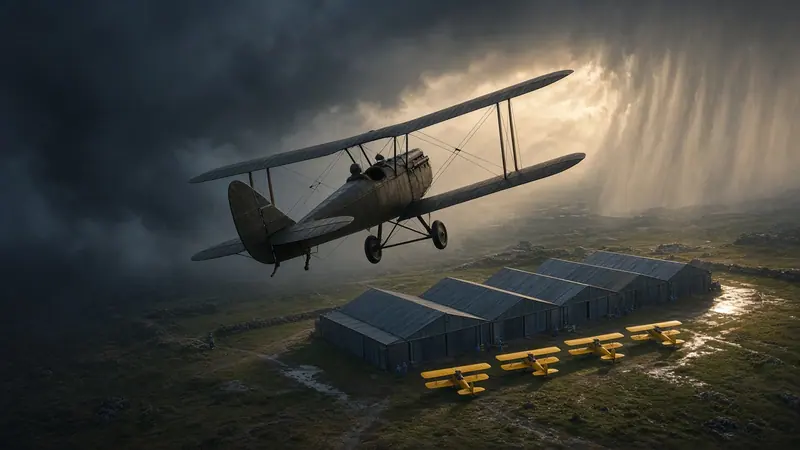
DREM, Scotland (1935): The way Victor Goddard told it, he was a quarter-mile from the airfield when the weather simply stopped.
He’d been fighting a storm over Scotland in an open-cockpit biplane, rain in his goggles, no radio, trying to find a landmark. He was looking for Drem, an old airfield east of Edinburgh that he knew was derelict. Then, as one widely retold version quotes him, “Suddenly the area was bathed in an ethereal light as though the sun were shining on a midsummer day.”
Below him, the ruin was gone.
What we know
On the record: documents, statements, dates and places. Sources below.
- The man. Sir Robert Victor Goddard (1897 to 1987) was no fringe figure. He was a career Royal Air Force officer who rose to air marshal, commanded the Royal New Zealand Air Force as Chief of the Air Staff from 1941 to 1943, and was knighted. He retired in 1951.
- His other story. Goddard became known for his interest in the paranormal. A separate account of his, a fellow officer’s dream in 1946 that foretold a plane crash Goddard then survived, became the basis of the 1955 film The Night My Number Came Up.
- When he told it. By the accounts collected by researcher Patrick Gross, Goddard didn’t write about Drem until 1966, three decades later. He set it out in his 1975 book Flight Towards Reality, which argued for extrasensory perception and other paranormal phenomena.
- The airfield. Drem was built as a World War I airfield. Gross notes it was vacated in 1919 and saw only occasional use by visiting squadrons from 1933 to 1939, before becoming RAF Drem, an important fighter station in World War II.
What’s claimed
Accounts, testimony and theories, as told by the people who tell them.
As the story is usually told, drawing on Goddard’s own account:
- The day before. Goddard, then a wing commander, visited Drem and found it falling apart: hangars in disrepair, fields fenced into pasture, cattle grazing on grass growing through the tarmac.
- The storm. Flying back in heavy rain, he lost his bearings, and in some versions his plane spun nearly to the ground before he recovered over the Firth of Forth. He headed for Drem’s hangars to get his bearings.
- The airfield. In an instant, the rain gave way to bright sunlight. The hangars looked new. Four yellow aircraft stood on the field, one of them a monoplane he didn’t recognize. Mechanics in blue overalls worked on them. He passed over at very low altitude, and nobody looked up.
- The match. Back then, as the story goes, RAF training aircraft weren’t yellow, mechanics wore brown or tan overalls, and the RAF had no such monoplane. By the end of the decade, the account says, Drem was back in service, trainers were painted yellow, mechanics wore blue and a monoplane trainer, identified in one retelling as the Miles Magister, had entered service.
The details shift
Retellings disagree. The Daily Record, quoting J.H. Brennan’s book Time Travel: A New Perspective, dates the flight to 1935 and calls the field “a disused airfield near Edinburgh,” though its own text also says “1939” at one point. A 1982 retelling quoted by Gross sets it in 1934 and puts Goddard in a Hawker Hart. Others say 1935. The color of the “missing” overalls varies between tan and brown.
The doubts
Gross, who catalogs aviation encounters, makes the main skeptical case:
- Yellow trainers. He writes that yellow was in wide use for RAF training aircraft from 1918 to 1939, so yellow planes in 1935 wouldn’t have been impossible.
- Monoplanes. He lists RAF monoplanes from long before 1935, starting with the World War I Bristol M.1, against the claim that the RAF had none.
- Visitors. Since Drem saw occasional squadron visits from 1933, he suggests Goddard may simply have seen a real visiting unit, and that people in blue may have been aircrew rather than mechanics.
- Timing. The bigger point is when the story surfaced. Goddard told it publicly decades later, long after Drem’s revival, yellow trainers and blue overalls were matters of record.
None of that proves Goddard invented anything, or that he wasn’t sincere. It means the details that make the story uncanny can’t be checked against anything written down before the changes happened.
Why it endures
The Drem flight is one of the founding stories of the time-slip genre, and the reason is the witness. It isn’t a passerby glimpsing something odd in a lane. It’s a senior airman, trained to read an airfield at a glance, describing one he says he couldn’t have seen yet.
Whether he flew through a gap in time or through a gap in memory, he came out of the storm with a story. He spent years of his retirement investigating and lecturing on the paranormal. And by his account, the Drem he saw that day, sunlit and busy, is the one that arrived a few years later.
Sources
- Victor Goddard (opens in new tab) · Wikipedia Career details and summary of the Drem account.
- Case of Edinburg, Scotland, U-K., in 1935 (ACUFO catalog) (opens in new tab) · Patrick Gross Collects the published versions of the story, including a 1982 Reader's Digest retelling, with Gross's critique. Last updated April 30, 2024.
- Fascinating story of time-travel in Scotland reveals pilot's eerie encounter on airfield (opens in new tab) · Daily Record 2018. Quotes J.H. Brennan's book Time Travel: A New Perspective.