Originally reported 2000 to 2001
The Man From 2036, Part 3: The Computer Nobody Needed
John Titor said he crossed six decades for a 1975 IBM 5100 and its 'simple and unique feature.' An engineer on the 5100 team later said a hidden feature existed. He also said the posts could have come from the internet.
Location IBM Rochester, Minnesota, where the IBM 5100 team worked; posts made online
Listen: Part 3
The podcast episode for this part.
ROCHESTER, Minn. (Originally reported 2000 to 2001): Of everything John Titor claimed, the strangest may have been the most ordinary. He said he hadn’t crossed six decades for gold, sports scores or a warning. He came for a computer.
“I was sent back to 1975 to get a computer,” TimeTravel_0 typed in an IRC chat on Oct. 14, 2000. “We need it in 2036 to recode UNIX which dies in 2038.”
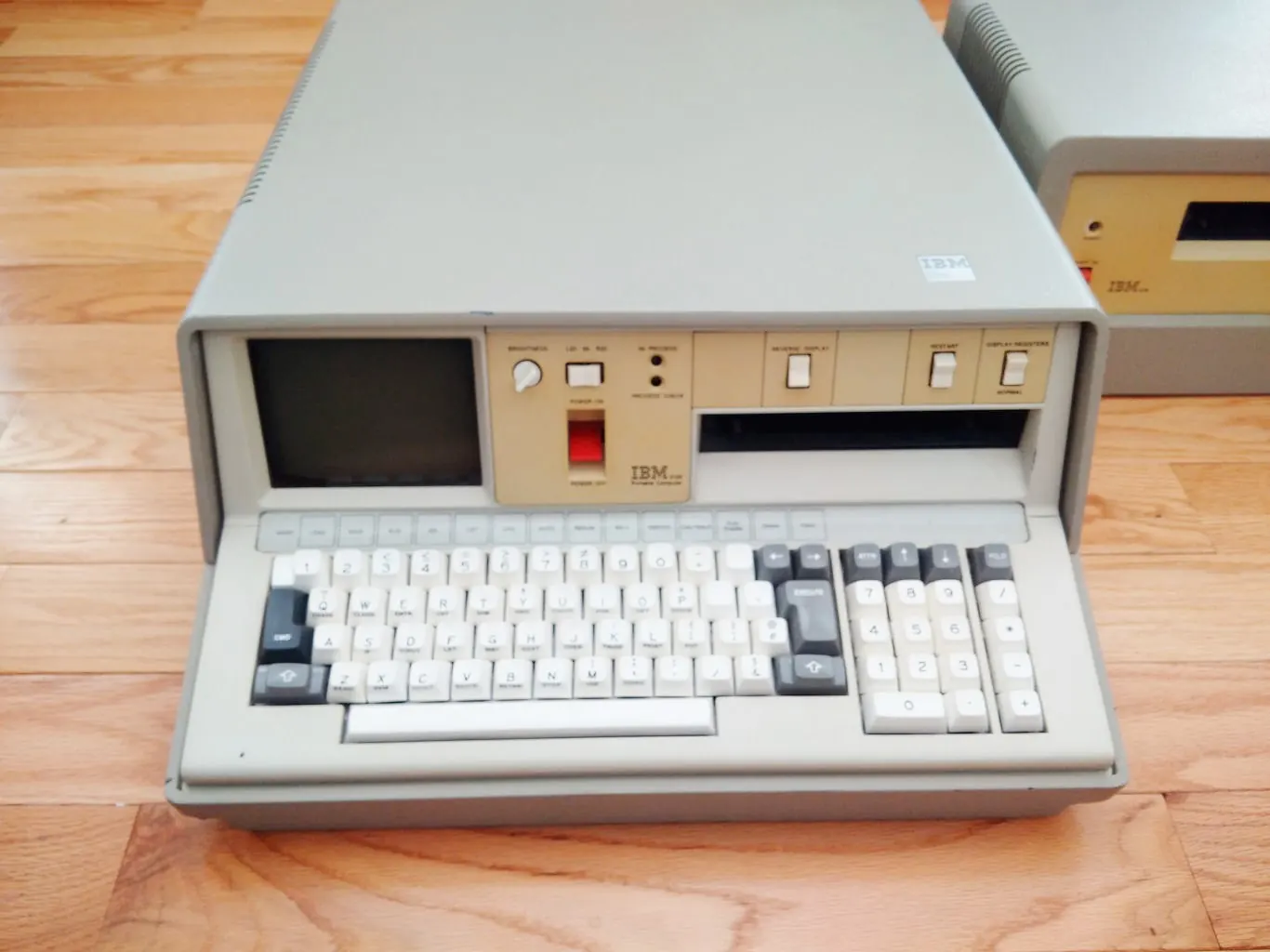
The machine he meant was built by an IBM team in Rochester, Minnesota. Its name became one of the most searched parts of the legend: the IBM 5100.
Rochester, 1975
IBM introduced the 5100 on Sept. 9, 1975. According to Wikipedia’s history of the machine, the company skipped the usual headquarters press event and sent 15 sales teams, each with a 5100, to demonstrate it at national news centers. It grew out of a 1973 prototype called SCAMP, built at IBM’s Los Gatos laboratory, and it sold for $8,975 to $19,975, depending on the model.
The trade press noticed. BYTE magazine’s December 1975 issue greeted it with “Welcome, IBM, to personal computing,” calling it “a 50-lb package of interactive personal computing,” though “at a premium price,” as quoted by Wikipedia. The Computer History Museum, which holds one in its collection, sums up the market’s verdict more briefly: “The IBM 5100 series was not a big seller.” IBM’s PC replaced the line in 1981, and the 5100 itself was withdrawn on March 31, 1982.
Twenty-five years later, TimeTravel_0 told the Time Travel Institute that the old machine held a secret, and that someone alive could confirm it:
“There must be an old IBM engineer out there someplace that worked on the 5100. They just might not have ever asked if I hadn’t pointed it out.”
Source: TimeTravel_0, Time Travel Institute, Dec. 30, 2000 (archived transcript, p. 68 (opens in new tab))
In the same post he described the secret. In 2036, he wrote, it was known “that the 5100 computer was capable of reading and changing all of the legacy code written by IBM before the release of that system,” and “I would bet the engineers were probably told to keep their mouth’s shut” (archived transcript, p. 67 (opens in new tab)).
What we know
On the record: documents, statements, dates and places. Sources below.
- The computer. The Computer History Museum lists the IBM 5100 as a portable computer announced in 1975. It had a 5-inch screen and a tape drive and ran BASIC, APL or both. IBM followed it with the 5110 in 1978 and the 5120 in 1980. Wikipedia dates the announcement to Sept. 9, 1975, and cites The New York Times, which called it “A 50-Pound Computer”; other sources put it closer to 55 pounds.
- Emulation was built in. According to Wikipedia’s account of the design, the 5100 ran its languages by emulating IBM’s bigger machines in microcode: System/370 for APL and System/3 for BASIC. That much was never secret.
- 5110 or 5100. In the IRC chat the traveler called it “an IBM model 5110” and said “My grandfather worked on it.” On the forums he named the 5100.
- The “feature” post. On Feb. 1, 2001, Titor wrote: “The 5100 had a very simple and unique feature that IBM did not account for and decided it was not in their best interest to advertise (which in hindsight was not very smart).” He said the feature was removed from later desktop computers, and that his unit needed “a couple of special “tweaks” that had to be done by one of the software engineers in 1975. Anyone who is familiar with this feature and was told to keep their mouth shut about it will be able to tell you what it is.”
- Why 2038. A week later he wrote that “UNIX will have a timeout error in 2038” and that the 5100 could “easily translate between the old IBM code, APL, BASIC and (with a few tweaks in 1975) UNIX.” The 2038 problem is real. Kaspersky explains that systems storing time as a signed 32-bit count of seconds overflow on Jan. 19, 2038, at 03:14:07 UTC.
- “I am not a computer expert.” Titor posted that line on Feb. 19, 2001, while others debated why the future wanted the machine.
What’s claimed
Accounts, testimony and theories, as told by the people who tell them.
- An engineer steps forward. In 2003, Rochester Magazine reached the IBM engineer it describes as the second engineer on IBM’s 5100 team in Rochester. At his request, the magazine now refers to him only by his initials, B.D., and so do we. A 2004 Rochester Magazine item, reproduced on johntitor.com, says the secret function “was his contribution to the design,” something “IBM suppressed because of worries about how their competition might use it.” It describes that function as “an interface between the assembly code surrounding the computer’s ROM exterior, and the 360 emulator hidden beneath it.”
- A letter about a “hook.” A letter posted on a forum and reproduced on johntitor.com, attributed there only to “an apparent IBM engineer who developed the 5100,” says: “One hook that was never documented for external IBM users was one for launching programs, written in the System 360 machine language, from APL.”
- The engineer’s doubts. The same engineer did not endorse Titor. The magazine reports that when it showed him the posts, he said the information was “derived from information available on the Internet” and that no member of the 5100 team would use the phrase “legacy code.” He once wondered whether a former teammate was behind it. “I’m not a ‘Star Trek’ watcher,” he said. “Somebody is just trying to tickle somebody else.”
- Two ways to read it. Believers point out that an obscure design detail matched an engineer’s account. Doubters point out that the detail may have been knowable in 2001. Both sides quote the same man.
The theories
The 5100 is where readers of the Titor story split most sharply, and each camp has its spokesman.
- The doubter in the thread. On Jan. 31, 2001, a Post-2-Post reader named Charles Moltrup asked the obvious question: “Why would you want a IBM 5100 I can find them at auctions for next to nothing” (archived transcript, p. 167 (opens in new tab)). Titor’s post about the machine’s “simple and unique feature” went up the next morning.
- The unexplained detail. The Time Travel Institute, which hosts the original threads, calls the feature “the part nobody has been able to answer”: how someone on a fringe forum in 2000 knew about an undocumented design detail of a 25-year-old computer.
- The insiders. Oliver Williams, who ran johntitor.com, said on The Moore Show in 2012, as quoted by Thrillist, that “Some IBM engineers came forward and said “I don’t know if that guy was a time traveler or not, but everything he said about that machine is true.""
- The writers’ room. Joseph Matheny, who says he consulted on Titor as a “literary experiment,” told Thrillist the 5100 idea came from his collaborators: “two of the people involved were older IT people. I didn’t come up with it, but when I saw it proposed I thought “that is so funny, we have to do that.""
- The well-informed hoaxer. The Telegraph, writing in 2015 after recounting the engineer’s confirmation, concluded that “Titor was at least a very well-informed hoaxer, a computer scientist or enthusiast who used his knowledge well.”
- The engineer himself. B.D. said the posts were “derived from information available on the Internet.” Rochester Magazine reports that he now declines to discuss it: “The response of being part of this has been too much.”
A hook on the case
One detail from Rochester Magazine’s 2004 item, as reproduced on johntitor.com, has become part of the lore. “An imprint of a hook on the outside of the 5100,” it said, symbolized the interface’s ability “to drop into what Titor called “legacy code,” and scoop out any necessary operating instructions.” That was the phrase B.D. said no one on his team would use. Titor had used it in his Dec. 30 post.
The legend later traveled further than Rochester. The 2009 visual novel Steins;Gate and its 2011 anime made a fictional “IBN 5100” a plot device, Wikipedia notes. Part 6 returns to that.
Titor himself never claimed to understand the machine. In the Feb. 19, 2001, post where he called himself no computer expert, he also wrote: “However, my job was to go and get it and not debate why they wanted it.” And: “One of the reasons I was sent to 1975 was because of the person I met there, not the technology” (archived transcript, p. 220 (opens in new tab)).
A 50-pound question
He said he had the computer, and that he would carry it home to a country rebuilding after a war. On Feb. 8, 2001, he asked readers to “keep in mind that civilization is recovering from a war.” “Yes, we do have the technology,” he wrote, “but many of the tools were lost.”
What war? He had been answering that question since November, with dates attached. Tomorrow, in Part 4: the civil war, the day he called N Day, and the America he said came after.
A note on the record: The original forum pages are gone. Every John Titor quote in this series comes from compiled transcriptions, chiefly “The Complete John Titor Posts” on the Internet Archive, whose editor writes that he “can not verify nor deny the accuracy of the source documents.”
Sources
- The Complete John Titor Posts (opens in new tab) · Internet Archive Compiled transcription; source of the Feb. 1 and Feb. 8, 2001, posts.
- Original Yareisa IRC conversation with TimeTravel_0, October 2000 (opens in new tab) · Time Travel Institute
- IBM 5100 Portable Computer (catalog entry 102636445) (opens in new tab) · Computer History Museum
- IBM 5100 (opens in new tab) · Wikipedia
- IBM 5100 page (reproduces 2003 forum letter and 2004 Rochester Magazine item) (opens in new tab) · johntitor.com
- John Titor: Who was the time traveler that visited Rochester? (opens in new tab) · Rochester Magazine / Post Bulletin
- Who was John Titor, the time traveller who came from 2036 to warn us of a nuclear war? (opens in new tab) · The Telegraph 2015; read via the Internet Archive's copy.
- Mitigating the Y2K38 vulnerability (opens in new tab) · Kaspersky
- The Oral History of John Titor, the Man Who Traveled Back in Time to Save the Internet (opens in new tab) · Thrillist Source of the Oliver Williams (2012) and Joseph Matheny quotes.
- John Titor: The Complete Story (opens in new tab) · Time Travel Institute Believer-leaning case summary.
- The Complete John Titor Posts (page-level links in the text) (opens in new tab) · Internet Archive Excerpts in this part link to the archived page where each appears: the Dec. 30, 2000, post (p. 67-68), the Jan. 31 and Feb. 1, 2001, posts (p. 167-168) and the Feb. 19, 2001, post (p. 220).