Out-of-Body Test Misses Its Target, but Two Participants Described the Researchers in the Next Room
In a University of Virginia study, 21 experienced practitioners tried to leave their bodies and read a hidden image. None succeeded. But two of them, unprompted, described where the researchers were sitting behind a closed door, and the trial records matched.
Location University of Virginia Division of Perceptual Studies, Charlottesville, Virginia (trial conducted in Brazil)
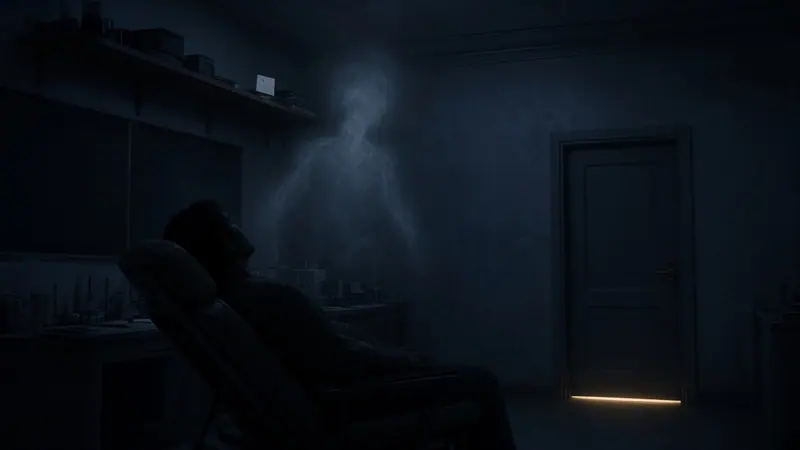
CHARLOTTESVILLE, Va. (study announced Sept. 10, 2026) — The target was an image on a laptop, its screen turned to face the wall, in a closed room 7 meters (23 feet) down a hallway. Not even the researchers knew which picture was showing.
Twenty-one people who say they can leave their bodies tried to go and look at it. None of them could say what it was. But two of them came back describing something else: the researchers, where each one was sitting, and what they were doing behind a closed door.
What we know
On the record: documents, statements, dates and places. Sources below.
- The study. A team led by Marina Weiler of the University of Virginia School of Medicine’s Division of Perceptual Studies published the results in the peer-reviewed journal Explore. The other authors are Damon Abraham, David J.P. Acunzo and Niffe Hermansson. According to UVA Health, the trial was conducted in Brazil and was supported by a gift from an undisclosed donor.
- The setup. ScienceAlert describes three rooms. Participants lay or sat in the first, connected to an EEG. The researchers waited in the second with the door closed. The third held a laptop displaying one image chosen at random from a pool of 100 objects. One researcher started the randomization program, turned the laptop toward the wall and left before the image appeared, and the target stayed unknown to everyone until the analysis months later. Each participant then had 60 to 90 minutes to try to see it.
- Who reported what. Of the 21 participants, 10 reported having an out-of-body experience and 13 gave descriptions of the target, according to UVA Health. The 13 included some who didn’t feel they had left their bodies but said they saw images on an internal “mental screen.”
- The main result. To take human judgment out of the scoring, the team used a language model to compare each description with all 100 possible images. According to ScienceAlert, the correct images ranked anywhere from 16th to 92nd, and the results overall were no better than guessing. UVA Health says the descriptions were not statistically more accurate than chance.
- The two descriptions. In interviews afterward, one participant said a researcher in the other room had been seated on the left looking at a laptop screen while another sat farther back reading a book, UVA Health reports. Another said one researcher had been seated on the right, taking notes, while a second sat on the left at the computer. Trial records confirmed both descriptions were correct at the time of those sessions. According to ScienceAlert, in both cases the researchers’ positions differed from their usual arrangement.
- How the researchers classify them. The two observations were spontaneous and weren’t part of the trial’s predefined measures, so UVA Health says they can’t be counted as evidence for out-of-body experiences. ScienceAlert notes they weren’t statistically analyzed and that the researchers describe them as anecdotal. According to the trial organizers, there was no way the participants could have seen the researchers.
What’s claimed
Accounts, testimony and theories, as told by the people who tell them.
- A new direction. “The unexpected findings give us a potentially useful new direction, but they also need to be tested prospectively and under rigorous conditions before we can know what they mean,” Weiler said in UVA Health’s announcement.
- Maybe the target was the problem. The team suggests that the kind of target may matter. Memorable, distinctive or emotionally engaging targets may be easier for participants to perceive, UVA Health reports. Future trials could add unseen details, such as a researcher wearing a distinctive or colorful item of clothing behind closed doors.
- What “real” means. “If studies demonstrate that people can obtain accurate information that they could not have accessed through their ordinary senses, we would have to reconsider some of our assumptions about the relationship between consciousness, perception and the physical world,” Weiler said. “At its deepest level, this research is not only asking whether out-of-body experiences are real. It is asking what we mean by ‘real’ in the first place.”
It has happened before
The researchers point to a similar moment in the 1960s, ScienceAlert reports. The famed out-of-body practitioner Robert Monroe failed to perceive a hidden target in an experiment, but reported seeing a technician outside the room with a man he didn’t know. The man was there. He was her husband, and Monroe had never met him. Psychologist Charles Tart, who ran that study, considered the evidence weak, noting that Monroe could have heard the visitor during a break.
Sixty years later, the laptop in Room 3 kept its secret. What the two participants described was in Room 2.
Sources
- Trial testing out-of-body experiences produces unexpected twist (opens in new tab) — UVA Health (via EurekAlert!)
- Assessing correspondence between subjective reports and visual targets during attempted out-of-body experiences (opens in new tab) — Explore (Elsevier)
- Scientists Tested Out-of-Body Experiences. They Failed The Test – But Something Else Happened. (opens in new tab) — ScienceAlert