'I Managed to Photograph the Legendary Skyfish!' A White Streak in a Japanese Fort's Doorway, and What 'Skyfish' Really Are
A ruins blogger's photo of an old artillery post on Cape Sada in Ehime, Japan, shows a thin white shape with rippling edges hanging in the dark doorway. Japanese readers cheered a 'skyfish.' The photographer thinks it was an insect, and the camera explains why.
Location Old artillery battery observation post, Sadamisaki (Cape Sada), Ehime Prefecture, Japan
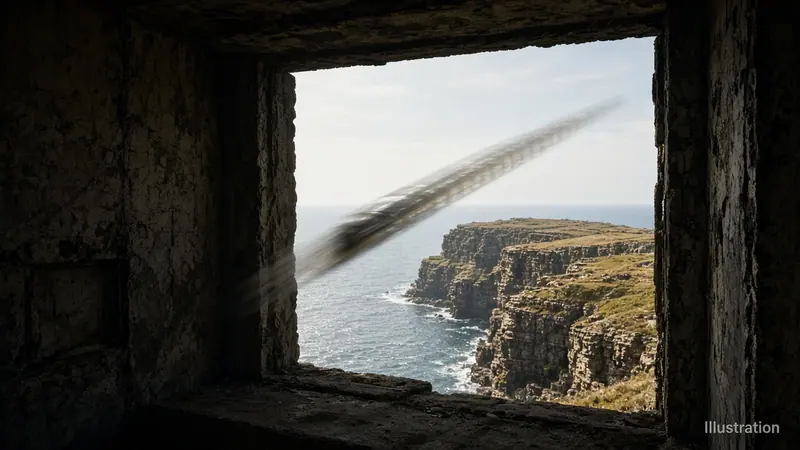
SADAMISAKI, Japan (Sept. 28, 2026): Cape Sada is a long, thin finger of land at the western tip of Shikoku, reaching out toward Kyushu. Out near its end, among the wind and the scrub, are the concrete bones of an old coastal artillery battery. Its observation post opens into the hillside through a dark doorway.
Where it started
The original social media post
-
@haikyotabe on X
伝説のUMA『スカイフィッシュ』が写真に撮れました!
Photo of a dark fort entrance with a thin white streak inside
Our translation I managed to photograph the legendary UMA 'skyfish'!
Posted just after midnight on Sept. 28, Japan time, by the author of the ruins blog 'Traveling Ruins.' UMA is the Japanese term for a cryptid.
From the conversation
-
トンボかなんかが飛んでてブレで羽が多く見えるんだろうな
Our translation Probably a dragonfly or something flying past, and the blur makes it look like it has lots of wings.
-
うおおお!!! これはスクープっすね!! きっとこの先の空間がねぐらに違いないです…!
Our translation Whoaaa!!! This is a scoop!! The space beyond must be where they roost...!
-
虫が高速で飛んでカメラに写るとこうなります。
Our translation This is what happens when an insect flies fast and gets caught on camera.
-
Posts shown as originally published; we don’t verify individual comments. Translations are ours. Retrieved . “Load the post here” fetches the original from X, which may set cookies.
Sometime around May of last year, a blogger who writes about ruins, Shinonome Myon, stood at that entrance and took a picture.
Months later, looking back through the photos, Myon noticed something hanging in the dark. Thin. White. Long. With what looked like rippling edges down its sides.
On Sept. 28, 2026, Myon posted it to X: “伝説のUMA『スカイフィッシュ』が写真に撮れました!” “I managed to photograph the legendary UMA ‘skyfish’!”
What we know
On the record: documents, statements, dates and places. Sources below.
- The photographer. Shinonome Myon runs the blog “廃墟を旅する” (“Traveling Ruins”) and posts on X as @haikyotabe. The Nishinippon Shimbun’s “me” news team interviewed Myon for a story published Oct. 13 and carried on Yahoo! Japan News.
- The place and time. The observation-post entrance of the old battery at Sadamisaki, in Ehime Prefecture. The picture was taken around May 2025.
- What Myon saw at the time. Nothing. “I only photographed the entrance. I didn’t see anything like a skyfish,” Myon told the paper. “So I was surprised it was in the picture.”
- One frame. Myon wasn’t shooting a burst, so there’s no sequence to compare.
- The reaction. The post drew more than 9,000 likes. Myon told the paper it got more of a response than an earlier post, adding: “Skyfish are famous, so I guess everyone loves them.”
What’s claimed
Accounts, testimony and theories, as told by the people who tell them.
Here’s the fun part. Myon doesn’t actually think it’s a creature.
“実際には虫が何らかの形でこのように写ってしまっただけだと思います,” Myon told the paper: “I think it’s actually just an insect that happened to show up like this somehow.”
Readers played along anyway. “More skyfish than I imagined!” one wrote, according to the paper. “This is a scoop!!” wrote another, adding that the darkness beyond must be where they roost. When someone joked that the tunnel led to a skyfish town, then a skyfish city, Myon replied: “スカイフィッシュの一大産地ですよ!” “It’s a major skyfish-producing region!”
Not everyone joined the game. “Probably a dragonfly or something flying past, and the blur makes it look like it has lots of wings,” replied one user. Weeks later, after the news story ran, another put it plainly: “This is what happens when an insect flies fast and gets caught on camera.”
So what is a skyfish?
“Skyfish,” also called “rods,” became a sensation in the 1990s, when videos began turning up long, thin, rod-shaped objects with wavy fins zipping through the frame faster than the eye could follow. Some believers proposed they were invisible airborne animals. In Japan, the skyfish became a classic UMA, short for “unidentified mysterious animal,” alongside the tsuchinoko snake and the kappa.
The explanation turned out to be the camera itself.
- Exposure time. A camera doesn’t capture an instant. The shutter stays open for a fraction of a second, and in a dark place like a doorway, that fraction gets longer.
- A fast insect. A fly, moth or dragonfly crossing the frame during that exposure doesn’t freeze. It smears into a streak along its flight path.
- The “fins.” The insect’s wings beat many times during the exposure. Each beat leaves a faint trace, so the streak picks up a row of ripples down each side. That’s the skyfish’s famous undulating fin.
- Why no one sees them. Because they don’t exist as animals. The streak only exists in the picture.
Tests with high-speed cameras alongside ordinary video have caught the same insects that show up as rods on slower footage.
None of that spoiled the fun. Japan has a long tradition of enjoying a good UMA with a wink, and Myon’s post is a perfect example: a great picture, an honest answer, and a comment section happy to imagine a whole skyfish city in the dark beneath an old fort at the end of a cape.
Sources
- 「やっぱりいたんだ!!」砲台跡の入口で〝伝説のUMA〟と遭遇!? (Japanese) (opens in new tab) · Nishinippon Shimbun me, via Yahoo! Japan News Oct. 13, 2026, 23:10 JST. Interview with the photographer. Translated by us.