Bigfoot's Most Famous Film Turns 59 on Oct. 20, With a Restoration and a Documentary About a 1966 Reel Out the Same Day
On Oct. 20, 2026, a Tulsa archivist releases a restoration of the 1967 Patterson-Gimlin film, and the documentary 'Capturing Bigfoot' arrives on Prime Video with a reel its director dates to 1966. Here's what each side says.
Location Bluff Creek, Northern California (the 1967 film); Yakima, Washington; Tulsa, Oklahoma
YAKIMA, Wash. (Oct. 7, 2026) — On Oct. 20, 1967, two horsemen from the Yakima Valley, Roger Patterson and Bob Gimlin, said they rode up on a tall, hair-covered figure crossing a creek bed in the Bluff Creek area of Northern California, and filmed it. Their roughly one minute of 16 mm footage became the most argued-over strip of film in Bigfoot history.
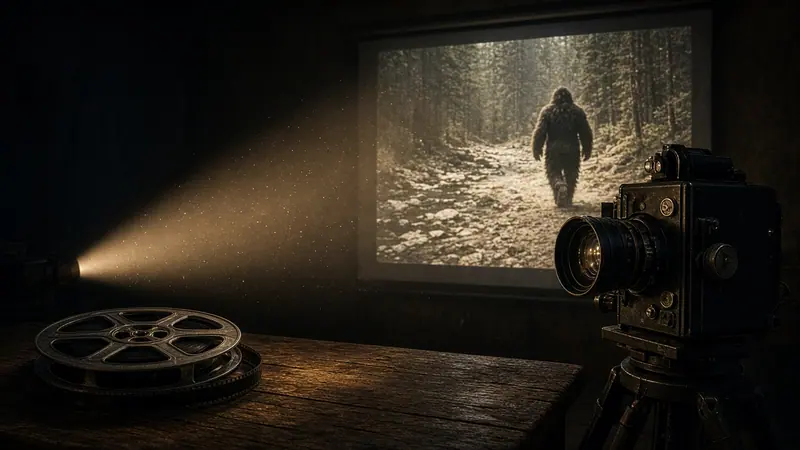
The poster is our story illustration, not a frame from the video. Pressing play loads the video from YouTube, which may set cookies.
On Oct. 20, 2026, the film’s 59th anniversary, two very different projects about it are due out on the same day. One is a restoration that its maker says is meant to preserve exactly what was recorded. The other is a documentary built around a reel its director says dates from 1966, a year before the famous footage was shot.
What we know
On the record: documents, statements, dates and places. Sources below.
- The restoration. On Sept. 12, 2026, News On 6 in Tulsa reported that film restoration specialist Todd Gatewood had completed a new restoration of the Patterson-Gimlin film from high-resolution scans of the original 16 mm Kodachrome II color film. It’s due out Oct. 20 on Vimeo, inside a documentary titled Bigfoot Revealed: The Unseen Patterson-Gimlin Film, with wider streaming planned later, the station reported.
- The documentary. Capturing Bigfoot, directed by Marq Evans, premiered at the South by Southwest festival in Austin on March 12, 2026. According to its Wikipedia entry, XYZ Films is releasing it in select U.S. cities and for digital purchase or rental on Amazon Prime Video on Oct. 20. On Sept. 29, 2026, the Yakima Herald-Republic reported a screening with the director and subjects at 7 p.m. on Oct. 24 at The Majestic Theatre in Union Gap, Washington.
- The people on camera. The Herald-Republic reports that the film includes interviews with Patterson’s son, Clint Patterson; Patterson’s widow, Patricia; Gimlin; and Bob Heironimus. According to Wikipedia’s summary of reviews, anthropologist Jeffrey Meldrum and makeup and effects specialist Bill Munns also appear.
- The rights. Capturing Bigfoot paid a $30,000 licensing fee to use the 1967 film, according to The Wall Street Journal as cited on Wikipedia.
What’s claimed
Accounts, testimony and theories, as told by the people who tell them.
The reel in the safe. According to Wikipedia’s account of the production, Olympic College film instructor Teresa Brooks brought Evans a reel of 16 mm film in June 2022. She had found it in a locked safe that belonged to her late father, Norm Johnson. Johnson had worked in a Boeing film lab in those years and was connected to Patterson and Gimlin through his brother, Wikipedia says, citing People. Evans, who teaches documentary filmmaking at Olympic College, told the Herald-Republic: “This is not the famous film we all know. We found out it’s dated from 1966, and it’s got a heck of a lot of similarities. So then the question was, well, what is it?” Wikipedia’s summary describes about 40 seconds of footage that the documentary presents as a rehearsal.
The family’s account. Clint Patterson says that about 10 years before Evans approached him, his mother told him the sighting was a hoax, according to Wikipedia’s summary of coverage in the Wall Street Journal, People and the Austin Chronicle. Writing in the July/August 2026 issue of Skeptical Inquirer, Benjamin Radford reported that Clint and Patricia Patterson both describe the film as a hoax. In his view, the documentary shows it was one.
The man who says he wore the suit. In 2004, Heironimus told the press that he was the figure in the film, wearing a costume at Patterson’s request, the Herald-Republic reports. The paper says he has told the same story since. Wikipedia’s cast list notes he “has given inconsistent testimony.”
Gimlin’s position. Gimlin has repeatedly denied that the footage was a hoax, while also expressing regret about being associated with it, the Herald-Republic reports. Radford wrote that Gimlin “has stuck by his story.”
Doubts about the new reel. Some of the film’s defenders question the 1966 footage itself. Matt Moneymaker of the Bigfoot Field Researchers Organization told The Times of London, as cited on Wikipedia: “My initial reaction is, how could you believe that in the age of AI? Even if they found some reel, how would you know whether what they’re showing in the documentary is what’s on the reel?” Evans told the same paper that the documentary uses no AI-generated material: “We’re 100 per cent confident in what we have.” Meldrum, according to The Hollywood Reporter’s review as cited on Wikipedia, “detects real mammalian musculature” in the 1967 figure. No independent analysis of the 1966 reel has been made public.
Two releases, one date
The two Oct. 20 projects take different approaches. Gatewood told News On 6: “This isn’t about creating a new version of the film. It’s about historically preserving what was actually recorded to museum-quality standards and giving people the opportunity to examine the footage while respecting the original photographic material.”
Evans told the Herald-Republic that disproving Bigfoot wasn’t his agenda. “For me, it’s a story about friendship and betrayal and reunions and family; promises kept and broken promises,” he said.
The Herald-Republic’s Sept. 29 report also recounts the film’s business history. Patterson’s brother-in-law, Yakima paving contractor Albert E. DeAtley Jr., had loaned him money to make the film and later said he never asked whether it was real. Twelve days after the 1967 shoot, Patterson and Gimlin went to Los Angeles and formed Bigfoot Enterprises to license the footage, the paper reports. Patterson died of cancer in 1972. In 1975, Gimlin sued DeAtley and Patricia Patterson over his share of the proceeds, and the case was settled out of court.
Fifty-nine years after the original footage was shot, the same figure can be seen on Oct. 20 in a restored version on Vimeo and on Prime Video beside the 1966 reel.
Sources
- New Bigfoot documentary brings Yakima connections into focus (opens in new tab) — Yakima Herald-Republic Sept. 29, 2026.
- Tulsa filmmaker restores 1967 Patterson-Gimlin Bigfoot film (opens in new tab) — News On 6 Sept. 12, 2026.
- Capturing Bigfoot (opens in new tab) — Wikipedia Source for the release plan and for quotes it attributes to The Times (March 20, 2026), The Hollywood Reporter and The Wall Street Journal.
- Bigfoot Documentary's Devastating Debunking (opens in new tab) — Skeptical Inquirer Benjamin Radford, July/August 2026 issue.