Something in the Woods of Bolla Ka'aguy: Paraguay Police Count Seven Newborn Calves Killed in 10 Days
In the farming community of San Felipe, in Paraguay's Misiones department, small ranchers say an unseen predator has killed and eaten newborn calves, sometimes leaving only the head. Police say the tracks aren't a dog's. Locals suspect a puma or a jaguar. Nobody has identified the animal yet.
Location San Felipe, Misiones department, Paraguay
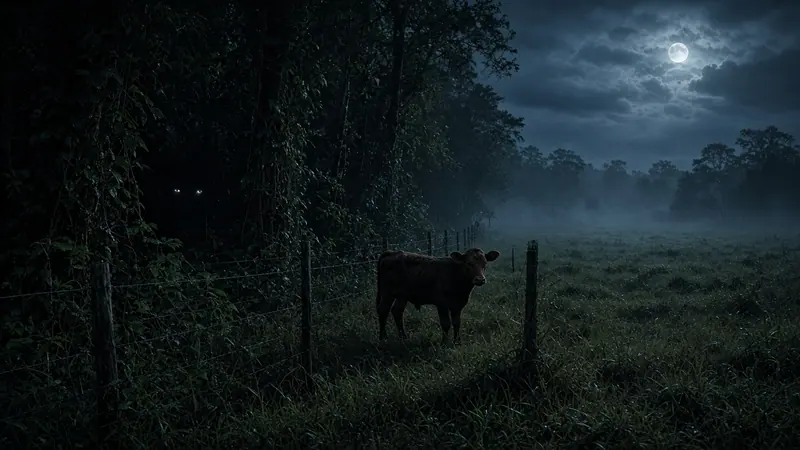
SAN FELIPE, Paraguay (reported Oct. 1–2, 2026): The last one was found two days before the story broke. A local rancher in San Felipe, a rural community in Paraguay’s southern Misiones department, came across what was left of a newborn calf: no jaw, no ear, one foreleg gone.
It wasn’t the first. According to the local police chief, about seven newborn calves had been killed over roughly 10 days in late September 2026, all near the same patch of forest. In some cases, he said, the animal ate everything. In others, it left only the head.
Nobody has seen it. Here’s what has been reported.
(Quotations from the Spanish-language coverage are our translations.)
What we know
On the record: documents, statements, dates and places. Sources below.
- The reports. Última Hora and Extra, both in stories by Vanessa Rodríguez on Oct. 1, 2026, reported that a large wild cat, presumed to be a puma or a jaguar, had killed about seven newborn calves over the previous 10 days near a wooded area known as Bolla Ka’aguy. ABC Color followed on Oct. 2, reporting the loss of about six calves among at least four ranching families.
- The police chief. The cases were reported to the police substation in San Felipe. Its chief, Senior NCO Víctor Jacquet, described the latest find to Última Hora: “We found the remains of a calf without a jaw, without an ear and without one of its front legs. In the other cases, they reported that the animal ate everything, and in some, it left only the head.”
- The latest attack. It was reported by a local rancher two days before the Oct. 1 stories, after he found the dismembered remains of his calf, according to Última Hora and Extra. That puts it around Sept. 29.
- The tracks. Tracks found in the area indicate the attacks weren’t by dogs, Última Hora reported, which points to a large predator. Extra went further and said the tracks “confirm” it. According to ABC Color, the affected families brought police images of tracks and marks found at the scenes.
- The forest. Suspicion centers on Bolla Ka’aguy, a stand of about 10 hectares (roughly 25 acres) bordering the Atinguy spring, where the animal is presumed to have its habitat or refuge, according to Última Hora.
- The response. Police formally notified the prosecutor’s environmental unit. A community meeting was called for midday Thursday, Oct. 1, at the field across from the San Felipe substation, with prosecutor Hugo Dávalos, police officers, and the head of the environmental sector of the Yacyretá Binational Entity (EBY), along with EBY specialists. Officials discussed placing camera traps at strategic points in the woods “to confirm the species and monitor its movements,” and drawing up a plan both to protect the herds and to conserve the animal, Última Hora reported.
- Technical teams. ABC Color reported that specialized technical teams went to the area to analyze the evidence, check the tracks and “implement technology” to determine with certainty which species is responsible. “The objective is to determine what type of animal is causing the attacks and to protect both the protected wildlife and the livestock,” Jacquet told ABC.
What’s claimed
Accounts, testimony and theories, as told by the people who tell them.
- A puma or a jaguar. Local ranchers presume the predator is a puma or a jaguar (yaguareté) roaming the fields, ABC Color reported. Neither species has been confirmed, and no photo or video of the animal has been reported.
- Two counts, two districts. The reports differ on some details. Última Hora and Extra count about seven calves and place San Felipe in the district of Santiago. ABC Color counts about six and places it in the district of San Ignacio. All three agree on the community, San Felipe, and on the police officer leading the response.
Protected animals
Officials stressed that the suspects are protected. Última Hora reported that authorities reminded residents that the puma (Puma concolor) and the jaguar (Panthera onca) are strictly protected under Paraguay’s Wildlife Law 96/92.
According to ABC Color, police said part of their goal is to keep poachers or residents from taking matters into their own hands against wildlife. Jacquet called for calm, and said that animals of this kind usually keep away from populated areas. Police said they would keep up a preventive presence in the area while the technical survey is completed.
Producers have been urged to shelter their young animals at night and to stay out of the woods unless accompanied by specialists, Última Hora and Extra reported.
Waiting on the cameras
For now, the predator of San Felipe is known only by what it leaves behind: tracks that aren’t a dog’s, a pattern of kills near one small forest, and a handful of families counting their losses. If the camera traps go up as planned, the woods of Bolla Ka’aguy may soon give up a picture of whatever is living there.
Sources
- Terneros atacados en Misiones preocupan y se sospecha de puma o yaguareté (Spanish) (opens in new tab) · Última Hora Vanessa Rodríguez, Oct. 1, 2026.
- Hallan restos de terneritos devorados en Misiones y sospechan que fue ataque de jaguareté (Spanish) (opens in new tab) · Extra Vanessa Rodríguez, Oct. 1, 2026.
- Preocupación en Misiones por ataques de presunto felino a animales vacunos (Spanish) (opens in new tab) · ABC Color Miguel Ángel Rodríguez, Oct. 2, 2026.